

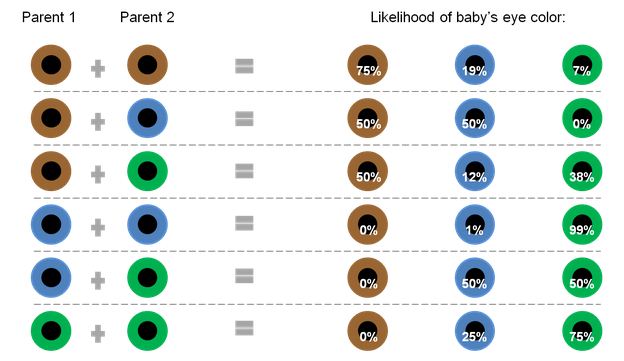
The Bio-Gene eye color inheritance chart is based on a theory that dates back to the 1800′s. It is not to be considered a reliable predictor of direct paternity. We provide the eye color inheritance chart ONLY as an educational service for our clients.
This eye color inheritance chart is used to determine either:
- The possible eye colors of the child when the eye colors of the mother and the father are known
or
- The possible eye colors of the father when the eye colors of the mother and child are known.
The Relationship Between Paternity, Eye Color and Inherited Traits
Determining paternity from eye color began as early as the19th century. Using the work of Gregor Mendel (1866), scientists began unlocking the secrets of inherited traits.
As theories about genes and human development were developed they eventually led to Watson and Crick in 1953 unraveling DNA as a double helix model. This opened the door for modern geneticists to sequence the entire human genome in 2001.
Mendel wrote that dominant genes masked recessive ones; and his study of plants with both dominant and recessive genes always showed the physical characteristics of the dominant gene. Over the years scientists were able to identify human traits linked to dominant and recessive genes such as ear lobe separation, blood type, and eye color.
Eye Color Traits
Eye color follows what is called a polygenic inheritance pattern, which means that eye color is determined by more than one gene. In truth it is probably determined by 6 or more genes! These genes tend to express themselves as one of 8 different eye color types ranging from light blue to dark brown, which can appear nearly black in color. The dominant genes make the eye color darker; the more dominant genes are present, the darker eye color appears.
Eye Color and Paternity Questions
Eye color is linked to dominant and recessive genes, and therefore eye color can provide some basic clues about paternity. An eye color paternity test begins with the assumption that lighter-eyed parents (those with recessive genes) cannot have darker-eyed children (who must have dominant genes as indicated above).
Using the chart below, you can determine the percentage of probability of a child having certain color eyes based on the parent’s eye color.
Why the Eye Color Paternity Test Can’t Be Trusted
Eye color cannot reliably answer paternity questions. Science is still working to better understand how multiple genes truly affect eye color—and whether other genes and other traits, such as skin color or hair color, might also be linked with eye color. Though uncommon, lighter-eyed parents sometimes do have darker-eyed children—even when a DNA test proves paternity.
Eye color cannot be determined accurately just by looking. What appears “blue” or “blue-green” to one may appear to another as “light-blue” or “hazel”—especially in different light. Eye color often appears much lighter at birth and may darken to its true color within 1 to 2 years.
Thus, eye color cannot reliably predict paternity. While an eye color paternity test may offer some clues about paternity, it is not consistent enough for definitive paternity test results. A Bio-Gene Paternity Test provides 100% accurate results. This testing can be done in private with a home testing kit, with results in as little as 2 business days. If there is any question as to paternity, let us help you get the answers you need and deserve through accredited DNA testing.